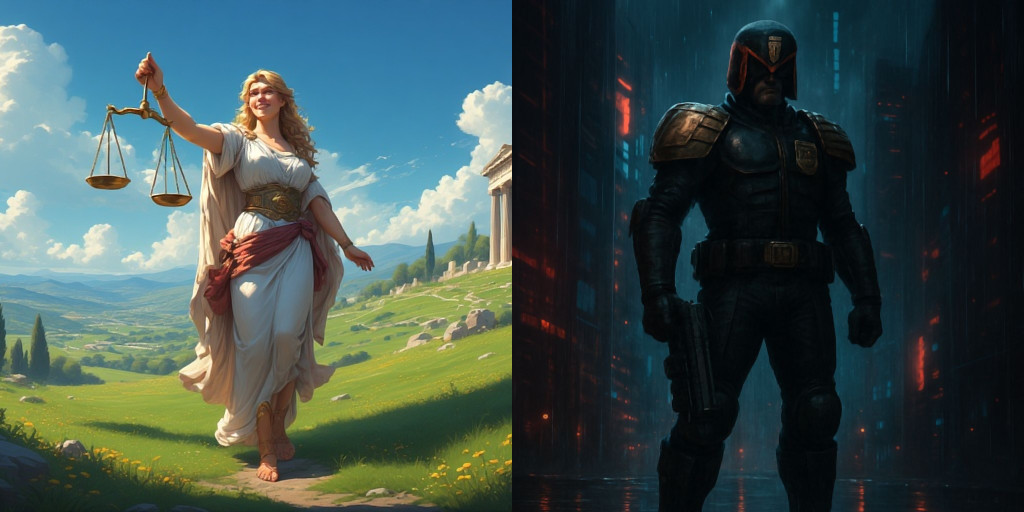
Although now freedom and fairness appear as antagonists, in fact, there is a deep connection between them. Therefore, it is very important to find a balance, although it is very difficult.
There can be no fairness without freedom. And at the same time, fairness guarantees freedom. Why, given such a close relationship, the manifestation of these ideas in real life is as we see it? It seems that the limitation of the human psyche is manifested here. Why keep two concepts in mind? Why look for balances? It is difficult for our psyche. After all, it is much more comfortable for our psyche to proclaim only one idea. The second will be only as a subordinate, and then it will be only because of the close relationship.
It’s very easy to reject one of the values.
Social justice is an empty phrase with no determinable content ©Friedrich Hayek
It is clear that fairness greatly interferes with absolute freedom. But this is bad, like any extreme. These are precisely the manifestations of the relationship in antagonism. The extreme degree of fairness will also look disgusting.
Analyzing historical and modern interpretations, it is very difficult to discard the ideological husk. Is the real freedom so free? Is the real fairness so fair? Any idea, even the most thoughtful one, can be spoiled by execution. Therefore, we always need to ask the question: what exactly do we dislike?
At the end of the article, one should try to understand in general terms what freedom is and what fairness is.
Freedom is not being a slave to any circumstance, to any constraint, to any chance; it means compelling Fortune to enter the lists on equal terms. ©Lucius Annaeus Seneca the Younger
The most primitive understanding of freedom is “freedom from” or freedom not to be a slave. Its other name is “Negative liberty”. It is clear that this is an integral part of true freedom, but in its ultimate form it is the freedom of a slave. A slave who dreams of becoming a master.
I am my own master. ©Isaiah Berlin
This part of freedom, called “positive liberty”, is also not true freedom. In its ultimate form, it is despotism.
If we rise to a higher level, it will become clear that there should not be a desire not to be a slave, there should not be a desire to be a master. There should be no slaves and masters at all. True freedom is generated by understanding your actions, taking responsibility for your actions. This understanding of responsibility leads to limitations. But this is a limitation of a truly free person who does not want to deprive others of their freedom.
Defining fairness is incredibly difficult. Even animals have a concept of fairness. The concept of justice is closely related to the development of society. What is acceptable for live animals is no longer acceptable for ancient people. What was acceptable to ancient people is unacceptable to medieval man. In the same way, the concepts of fairness in the Middle Ages seem wild to us. Hence, it can be understood that the concept of fairness becomes more complicated with the complication of society. In the same way, there are examples of simplification of this concept in a degrading society. Hence the words that social justice is an empty phrase. This is an empty phrase for which society? At what stage of development is this society?
For some time now, fairness began to be expressed in the form of laws. Ideally, these laws should be based on our historical understanding of fairness. And this is where the problem arises. If society develops, then the laws become obsolete. If society is degrading, then the laws are redundant. They cannot be provided by this society and lead to the termination of the work of many other laws. It is very good if there is a constant development of society. We can come to terms with outdated laws. Revision of legislation can be sought. But how to be in a situation where the laws are not followed.
In addition to the official laws, there are also unwritten rules. It is they that social animals have, and people were guided by them before the laws appeared. Which are formed from the public understanding of fairness in a given society. It would seem that this is where the laws should be taken from. But public understanding of justice is volatile.
In my opinion, the best definition of social justice was given by John Rawls. According to his definition, the basic liberties are:
- Freedom of thought;
- Liberty of conscience;
- Political liberties;
- Freedom of association;
- Freedoms necessary for the liberty and integrity of the person;
- Rights and liberties covered by the rule of law.
Notice that how often freedoms are mentioned here. This once again confirms the relationship of freedom and social justice.
And now I invite you to ponder whether social justice can be equated with fairness. Or social justice is only one of the components of fairness.