Here I’ll summarize my list of physics questions. Some are simple, arising from my encounter with a previously unknown area. Perhaps the answer has been there for a long time. I just need to find it. But before I find the answer, I first need to ask a question.
There are a lot of stupidities and mistakes in my head, but I realize this: Мystification. Traps in the human mind.
List of questions:
#1. Why is it so difficult to create and calculate a model of even a single atom, let alone a molecule, while in the real universe even the merger of supermassive black holes is “calculated” in real time?
The answer has been found, in “only” about 20 years: How does the universe “know” what to do?
. . .
#2. What happens to the non-zero energy of the physical vacuum inside a massive object?
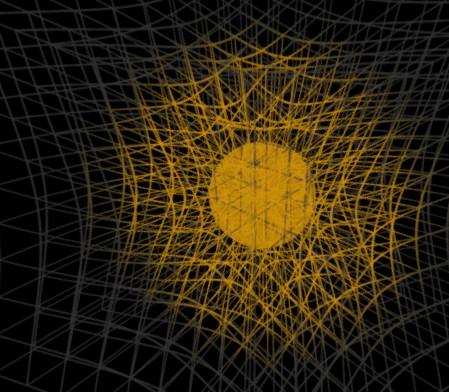
If I look at this model of space-time curvature, I get the feeling that space disappears inside a massive object, but the physical vacuum has non-zero energy.
I’m starting to think I’m simply lumping together general relativity and quantum field theory. Spacetime curvature and vacuum energy are from different theories that haven’t yet been able to be combined into a unified theory of everything.
. . .
#3. Could there be some connection between redshift and light passing through gravitational lenses?
The answer seems simple: no, it would just create a delay. But I have a feeling it’s not that simple. After all, even in empty space, there’s a small amount of matter. Couldn’t there be some effect here?
. . .
#4. In how many dimensions do quantum fields exist?
For example, in the electromagnetic field we can easily detect 2 dimensions.
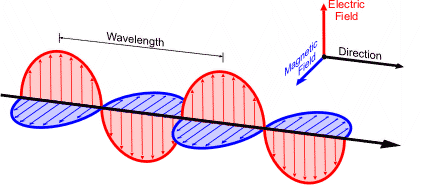
In this case, sometimes both the magnetic and electric components become zero. But, if remember about polarization, maybe this is not a separate field, but two tightly connected fields. And perhaps even more than two fields. We see this manifesting on the macro level and call it EMR. But what happens in quantum fields is much more complex.
What about, for example, the lepton field? Or the quark field?
Can all fields simply occupy all 3 spatial dimensions known to us?
. . .
#5. If disturbances in quantum fields are added up in an analogous way, then how can explain discreteness?
Related to question #1 and its answer.
. . .
#6. How the Higgs field gives particles mass.
Related articles:
. . .
#7. Why should a baryon be color-neutral?
And how does this relate to the fact that an individual quark cannot be isolated.